RX Direct · Weight Management
Use Food Labels to Make Clearer Everyday Choices
Understand the numbers on ordinary supermarket foods, compare similar products fairly and keep labels useful without turning every purchase into a calculation.
Quick Answer
We explore how to read food labels for weight loss to support your lifestyle changes on weight loss medication.
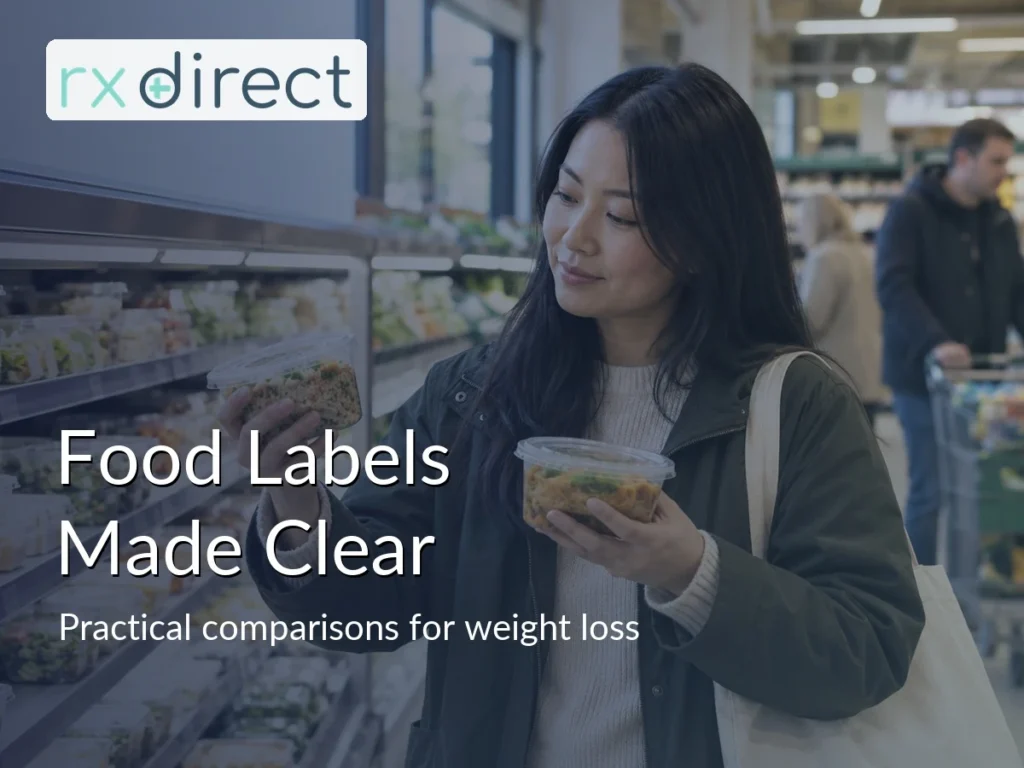
Use the per 100 g figures to compare similar foods, then check the portion you actually expect to eat. Traffic-light labels can help you spot differences in fat, sugar and salt, but one colour or claim does not decide your whole diet. Start with a few foods you buy regularly rather than trying to analyse an entire supermarket.
Our weight-loss service starts with an online consultation form so a prescriber can assess suitability. A prescription is not guaranteed.
Decide What You Want the Label to Help With
Food labels for weight loss are most useful when they answer a small question. You might want to compare the salt in two soups, find a cereal with more fibre or understand how much of a ready meal the numbers describe. That is easier than trying to find a perfect food with no ingredient you have ever been told to avoid.
A label provides information about the product. It does not know your appetite, health conditions, allergies, budget or what else you eat. Start with one category you buy often and one useful comparison. Leave room for taste and convenience because a food you will not eat is unlikely to improve your usual pattern.
If appetite changes on Mounjaro have changed your serving size, the portion on the package may be even less representative of what you eat now. Check the basis of the numbers before deciding that a food is too high or low in something.
- Choose two genuinely similar products to compare.
- Find whether figures are per 100 g, per 100ml or per portion.
- Check the quantity in the package.
- Consider the amount you normally serve.
- Keep the whole meal and your health needs in view.
Use Per100 g Figures for a Fair Comparison
Different manufacturers can use different serving sizes. A cereal label may describe a small bowl while another uses a larger bowl. Comparing those two portion columns directly could make the smaller suggested portion look better even when the foods are similar. Per100 g information puts comparable foods on the same starting basis.
The NHS explanation of nutrition labels describes this distinction. Once you have compared products fairly, use the serving information to understand what you will eat. You do not have to weigh every ingredient indefinitely, but an occasional measurement may help if the stated portion is hard to picture.
Do not compare unrelated foods solely by their calories per 100 g. A cooking oil and a soup have different roles, water contents and serving sizes. The relevant question is how each fits into your meal, not which has the smaller number on the same line.
Check the Real Portion Before Doing the Maths
A package can contain several manufacturer-defined portions even when it looks like one meal. Read the wording carefully. If the front says per half pack and you expect to eat the full pack, the numbers for your meal will differ. Sauces, dressings or separately added ingredients may also need consideration.
The table uses invented numbers solely to demonstrate arithmetic. It does not describe a real product or a recommended meal size. The point is to notice how a serving changes the calculation, then use the figures from the actual package you buy.
On smaller screens, scroll the table sideways.
| Example Label | Amount Eaten | Illustrative Energy |
|---|---|---|
| 200 kcal per 100 g | 50 g | 100 kcal |
| 200 kcal per 100 g | 75 g | 150 kcal |
| 300 kcal per half pack | Whole pack | 600 kcal |
| 120 kcal per stated serving | Two stated servings | 240 kcal |
You can apply the same method to another nutrient, but do not feel you must calculate every line. Choose the information relevant to your aim. If a clinician has set a specific dietary requirement, ask which numbers matter most and how to interpret them.
Treat Traffic-Light Colours as a Quick Signal
Red, amber and green labelling can give a quick comparison of fat, saturated fat, sugars and salt. It is a starting point, not a judgement of your character or a rule that one red label forbids the food. Similar products may differ in useful ways, and the quantity and frequency you eat also matter.
Choose a comparison you can repeat without making shopping much harder. You might check two usual sandwich fillings or two sauces. If one has less salt and you enjoy it, the swap may be useful. If the product does not fit your allergies or dietary advice, a favourable colour does not make it suitable.
The British Heart Foundation’s portion guidance adds another part of the picture: the amount matters alongside the type of food. A small change in a food you use regularly may be more useful than analysing a food you only eat occasionally.
- Compare similar foods rather than unrelated categories.
- Look at more than one colour where time allows.
- Check the portion behind the front-of-pack information.
- Avoid treating a single red label as a ban.
- Choose changes that still leave meals enjoyable and practical.
Look Beyond Claims on the Front
High protein, reduced fat, no added sugar and natural describe particular features or marketing messages. None means the product is automatically a balanced meal, low in energy or better for your circumstances. Use the nutrition panel and ingredients to understand the claim in context.
For example, no added sugar does not necessarily mean no sugar. The total sugars line includes sugars naturally present in ingredients as well as those added. A higher-protein snack may still be expensive or unsuitable as a replacement for an ordinary lunch. A reduced-fat version is compared with another version, not with every food in the aisle.
If you want to increase fibre, the NHS fibre information explains how to find it on labels when it is given. Check the actual food and serving rather than choosing a product solely because its packaging looks wholesome. You do not need to buy a specialist diet range to use labels well.
Separate Ingredient Checks From Nutrition Comparisons
The ingredient list and nutrition panel answer different questions. The ingredient list helps you see what is in a product; the nutrition panel gives quantities for selected nutrients. Allergen information takes priority if you have an allergy. A low-salt or high-fibre food is not a safe choice if it contains something you must avoid.
Ingredients are generally listed in order of their weight in the recipe. That can help you understand the main components, but an unfamiliar ingredient name is not by itself proof that a food is harmful. Avoid using ingredient length as a substitute for an actual nutrition or allergy check.
Keep your decisions specific. Ask a pharmacist or dietitian if a product or supplement makes health claims you do not understand. Labels cannot tell you whether an ingredient interacts with a prescribed medicine, and a social-media ingredient blacklist cannot replace individual advice.
Use Labels to Support a Smaller Eating Pattern
When treatment reduces appetite, the lowest calorie option is not automatically the right aim at every meal. You still need adequate food and variety. Look at whether a smaller meal contains something useful to eat rather than congratulating yourself for choosing the smallest energy number.
If Wegovy side effects or Wegovy Pill side effects are making intake difficult, tell your prescriber. Label reading can help compare foods, but it cannot assess persistent sickness, weakness or inability to eat. Those concerns need a clinical conversation.
For people considering Wegovy, Mounjaro or a Wegovy Pill, we assess suitability through an online consultation form. A nutrition label does not establish eligibility or choose a treatment. It is one practical tool within a broader eating and care plan.

Make Your Next Shop Simpler
Pick three frequently bought foods and check them properly once. Keep a note of suitable options if that makes future shopping easier, but allow for recipe or package changes. You can then spend less time on those decisions and concentrate on the rest of the meal.
A rushed shop may only allow one check. That is still useful. Read the portion, compare the relevant nutrient and choose a food you can use. You do not need to convert every label into a score. A more confident shop is the aim, not a longer shopping list of foods you are afraid to buy.
- Start with products you buy most weeks.
- Compare a usual option with one realistic alternative.
- Check whether the price difference matters to your budget.
- Keep convenient choices that help you prepare a meal.
- Review labels again if the product or package changes.
Understanding why weight change can be uneven can also prevent you from treating one supermarket swap as a guaranteed solution. Repeated habits matter in context; no label predicts your individual result.
Keep Numbers in Their Proper Role
Some people find numbers helpful; others find them upsetting or distracting. If counting is becoming compulsive, meals are getting smaller through fear or shopping takes excessive time, tell a healthcare professional. You can discuss a food-based approach that relies less on detailed calculation.
Labels are information, not instructions to meet a universal daily target. Your BMI and wider health assessment also require context rather than a single cut-off. The same principle applies in the supermarket: use the information to support an informed decision, and ask for help when individual needs make the decision more complex.
Try one change at the next shop and notice whether it makes your routine easier. If it does, keep it. If it makes meals less practical or enjoyable, choose a different comparison. Clearer choices should help you eat, not leave you unable to choose anything.
Frequently Asked Questions
Are Kilojoules and Calories Different Things?
They are different units used to describe energy. Food labels may show both kJ and kcal, with kcal commonly called calories. Compare the same unit across products. You do not need to learn a conversion for every shop; focus on understanding whether the figure is per 100 g, per 100ml or per serving.
Does the Sugars Line Tell Me How Much Was Added?
Not on its own. The total sugars figure includes different sources of sugar in the food. Read the ingredients for further context, but do not expect the panel to provide a separate added-sugar quantity in every case. If you need specific advice for a health condition, discuss the whole eating pattern with your clinician.
Can I Rely on a Food-Tracking App’s Entry?
Check it against the current packaging. App entries can describe another product, recipe or serving size, and products can change. A barcode scan is convenient but not proof that every number is correct. If you use an app, make sure the portion you log matches what you actually ate.
What If the Label Describes Dry Weight?
Read the preparation instructions and the wording beside the nutrition figures. Dry and prepared weights can differ, particularly when water is added. Do not mix a dry-weight figure with a cooked-weight portion without understanding the basis. Contact the manufacturer or ask a dietitian if the label is unclear.
Do Restaurant Calories Give an Exact Personal Measure?
No. Where displayed, they describe the menu item as specified, with variation possible in preparation and additions. They cannot account for your personal nutritional needs. Use them as information alongside ingredients, portion preferences and the rest of your day, rather than as a reason to skip food before a social meal.
Should Children Follow My Label-Based Weight Plan?
No. Growing children have different needs from adults receiving weight-management treatment. Do not impose an adult calorie target or restrictive shopping rules on them. You can share varied household meals, but concerns about a child’s growth or weight should be discussed with an appropriate healthcare professional.
Can Labels Tell Me Whether a Meal Replacement Is Suitable?
They describe its contents, but suitability depends on why you are using it and your health. Do not assume a shake or bar is a complete replacement for ordinary meals because it contains vitamins or protein. Ask a clinician before using a restrictive replacement plan, especially if you take medicines or have an eating concern.
Build a Weight Plan Around Real Everyday Choices
Tell us about your health and current eating pattern through our online consultation form. A prescriber will assess treatment suitability. Label reading can support food choices, but it does not establish whether a medicine is right for you.
Medical Information
This article provides general information for adults and does not replace individual medical advice. Follow your own care plan and the leaflet supplied with any medicine. Our online consultation assesses suitability; a prescription is not guaranteed.
Clinically Reviewed by Pharmacy Mentor
A pharmacist reviews the content to help ensure medicines are presented responsibly and that patient-facing health information is accurate, appropriate, and aligned with current clinical guidance.
Written on behalf of RX Direct by Pharmacy Mentor.
Added: . Editorial review: 8.